


Green Mountain Timber Frames
Connecting Vermont's Past, Present, and Future
STORY BY STEPHEN PIERCE PHOTOGRAPHY BY JOHN PATERSON
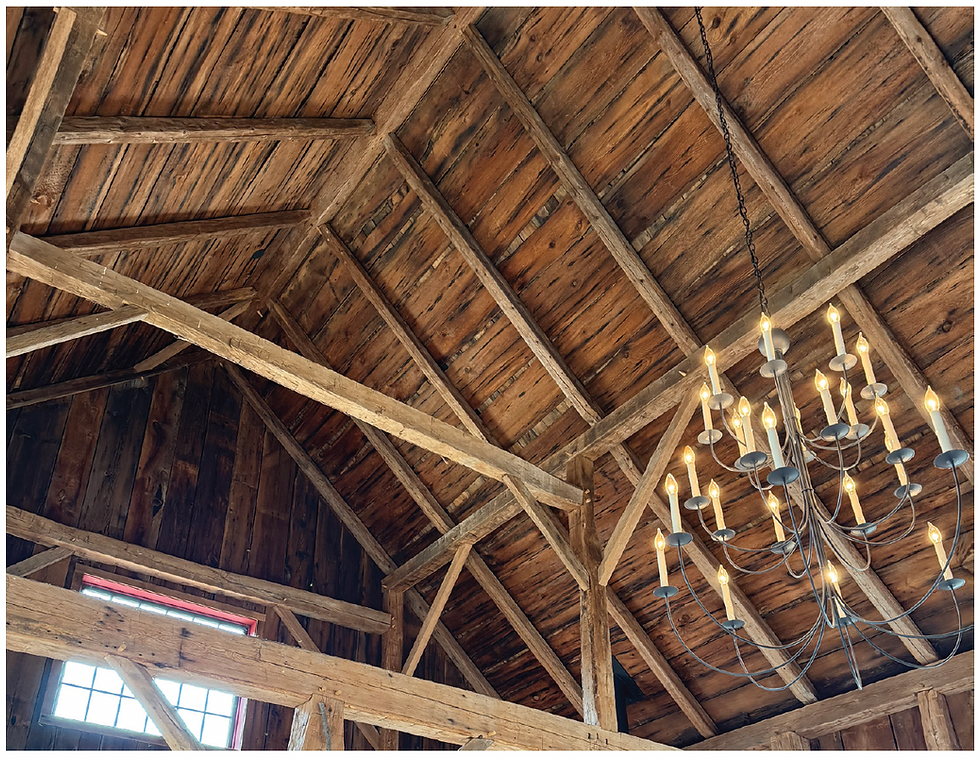
I’m standing in a high-ceilinged, reconstructed timber barn in Middletown Springs, VT with owners Luke and Sarah Larson, staring up at its massive ceiling beams, many of which were hewed from trees that first grew in the early 1600s, nearly two hundred years before our country became a nation.

The darkened cuts made by axes swung by early American farmers are still visible, and if I let my imagination wander, the voices of those who once worked in the barn’s former life, even centuries ago, might still be heard.
“This is the old Reuben Waite barn,” explains Luke, owner of Green Mountain Timber Frames, the 43-year-old company specializing in locating, restoring, and re-erecting historic, hand-hewn timber frames and old barns, transforming them into custom homes, studios, or additions.
Stunning examples of their meticulous work can be seen throughout Vermont and surrounding states, and even as far south as Virginia, where the company re-erected an old timber frame as a small chapel. According to the owners, “Luke completely understood our vision. He drew on his own past experience to add the details and finishing touches to an early 1800’s granary and transformed it into a tiny country chapel, bell tower and all.”
The company’s website abounds with similar testimonials, praising Luke and his team not only for the unique beauty of the finished product, but also for their knowledge, attention to detail, and reverence for the workmanship of the original builders.
The Reuben Waite Barn Showcase
The Reuben Waite barn, re-erected on the Larson’s property in 2022, is both a workshop and showcase for potential clients, but a quick glance around its spacious interior reveals that it serves as much more. Early American-style brooms hang from a wall; antique, handmade tools—including a broad axe that looks as if it were used in the War of the Roses—lay scattered about; an original cast-iron Glenwood stove sits in one corner; and in the barn’s center sits a long teakwood table for meetings and community classes.

Clearly, the Larsons’ work involves more than saving old, rotting barns; they are also working to preserve part of Vermont’s past. The Reuben Waite barn is a perfect example.
As they always do when salvaging an old barn, Luke and his wife, Sarah, researched local records offices and talked to people in the barn’s original hometown. According to Luke, “We discovered that Waite himself came up from the Connecticut Valley, but we’ve traced his original roots back to Scotland.” Waite, they learned, was not only a farmer, but also a cooper and a pastor. “He started three different churches, and at some point, erected this barn.”
Following the genealogy of the barn led the Larsons to descendants of Waite himself, including a 105-year-old woman named Eva, who had grown up on the Waite farm in Galway, NY, where the barn had stood for generations. The family did not want to see the barn collapse and disappear, so they sold it to the Larsons, who became, in a sense, the next stewards in its long history.
Studying the timbers themselves is also essential to what the Larsons do: the barn’s exact age, the specific hew marks still visible, and the style of joinery utilized. Luke explained that dendrochronology-–the process of taking a core sample from either a living tree or hewed beam to determine its age—has determined that the Reuben Waite barn dates back to 1796–97. He also noted that these old beams reveal much more than age, stating, “This is why we often call trees ‘the scribes of nature.’”
“It’s incredible,” Sarah interjected. “When we visit structures, along with the farmers and families who have been working that land—they step into these barns with us and immediately start telling stories. But if you look closely, the structures themselves tell stories as well, and we try to honor that history and pass it on to a new owner.”
In fact, the Reuben Waite barn itself has already become a kind of bridge between past and present. When the Larsons re-erected it on their property, a group of senior citizens from Galway chartered a bus to Middletown Springs for a celebratory lunch and talk about the restoration. Among them were descendants of Eva, who unfortunately passed away before the event. For many, it was an emotional experience, watching what felt like the resurrection of their own family’s past.
Sarah recalled Eva’s story of her father driving the farm’s first automobile into the barn, becoming flustered, and jolting it right through the opening on the opposite side, yelling, “Whoa! Whoa!” at the vehicle as if it were a team of horses.
Saving Barns, Preserving Histories
Business often starts, Luke said, with a phone call. The Larsons have built a multi-state network of people on the lookout for old, neglected barns. Sometimes, though, it is a new property owner who calls to say, “We have this old barn that needs saving,” or perhaps it’s someone with a collapsing stone foundation who wants to find a period barn to replace what was lost.
“We take very seriously the process of removing the structure from its original location,” Luke said. Ideally, he explained, they prefer to preserve the structure where it stands. But if the original owners cannot afford to do that, the Larsons would still rather see the barn saved than collapse into the earth. Part of the company’s philosophy is to keep a structure as close geographically to its original site as possible. “We prefer to keep Vermont barns in Vermont if possible,” Luke explained.
After the preserved timbers are labeled and stored, and once a new owner and location are found, that is when the real joy begins. The event of bringing an historic structure into a community often generates high enthusiasm, and Luke not only arrives with a team of builders to erect the frame, but with a trove of historical information on the barn and its former owners culled from town and county records and local residents’ stories.
Luke’s Roots in Vermont Craft and Agriculture
Luke came by his love of woodworking, barns, and the Vermont landscape naturally. He grew up on a dairy farm in Wells, VT, just 15 minutes from where we stood. He spent his days in old barns, but he also recalls that, as early as age eight, he would walk a mile through the woods to his grandfather’s woodworking shop.
While his grandfather worked on some project, Luke would take his jackknife and whittle. “I wasn’t necessarily trying to create anything,” he said. “I was fascinated with the grain of the wood—the different colors, patterns, and softness.” By 16, Luke had built a canoe by himself. Soon after, he built his first timber-frame structure under the guidance of his mentor, Dan Kean.
Eventually, Luke left for college before studying briefly in England where he spent time around “much older buildings than I had ever experienced, which was amazing.” After considering graduate school, Luke decided to come back to Vermont, stating, “I loved it too much.” He returned to work with Kean full time from 1996 on, eventually buying the business from his mentor.
“A through-line for me,” Luke said, “is growing up on a Vermont dairy farm and spending time around barns, embedded in the agricultural world, and then spending much of the rest of my life trying to preserve—and even grow—that culture.”
Sarah’s Vision and a Shared Mission
Luke and his wife Sarah originally met in college, but they reconnected around the time Luke was taking over his mentor’s timber-frame business. Sarah, a business major, had worked in nonprofit and educational restoration projects, including Schooner Adventure in Gloucester, MA, where she helped teach visitors about the value of saving the past, of restoring instead of discarding.
When she and Luke began their life together, she was ready for a new path. “Here I was with this artist,” she said of Luke, “who had this incredible vision and passion for the same things I did, and it just made sense that I could be helpful on the business end.”
After erecting the Reuben Waite barn, they began thinking about how best to use the space. Certainly, it would serve as a stunning showcase for prospective clients, but Sarah also envisioned it as a dynamic gathering place. That idea led directly to the second part of the company’s mission: not only to preserve New England’s heritage through saving timber-frame structures and the material culture found within them, but also to preserve the wisdom and knowledge those builders possessed and pass it on to future generations.
In the spring, they host community workdays, including the planting of broomcorn. In the fall, they harvest it and bring in an instructor to teach natural broom-making. They also run a black ash basket-making class and have re-erected an old blacksmith shop that they brought over from Benson, VT. Says Sarah, “Watching kids try out the various blacksmith tools, the massive bellows—-it’s amazing.”
The workshop hosts timber-framing classes, of course, but also a poetry reading series. “This winter we had Poet Laureate Bianca Stone in here, and it was wonderful,” Luke said.
For their building team and apprentices, the programming is equally intentional. “Once or twice a month we host what we’ve come to call ‘Fun Fridays,’” Luke said. “In the winter, for instance, we fire up the wood-burning stove in our workshop. We usually start with some reading time around the stove. Then we’ll work on some woodworking skill—maybe hand-cut dovetail work or steam-bending. Often the participants’ families will come for a big lunch, and then afternoons provide time for members to work on various personal projects.”

What the Old Timber Frames Still Teach
When Luke talks about barns, he does not speak of them as static relics. To him, they are records of past builders’ knowledge. He demonstrated what an older woodsman or framer could discern simply by studying a tree and its wood: how it grew, what the weather had done to it, how it would shrink and swell, how it ought to be cut and joined.
For example, older framers offset peg holes so that, when the wooden peg was driven through a mortise-and-tenon joint, it bent slightly and then pulled the joint tighter as the wood dried and shrank.
He also explained how these builders were often looking to the future. Even though a round wooden peg driven through the mortise-and-tenon pieces reached its maximum strength once it met the other side of the mortise beam, those older framers often bored the hole—and then hammered the peg—through the other side of the entire joint for a reason: so that someone coming along much later could find the end of that peg, drive it back out, and repair the joint if needed.
Luke also pointed out that timber framing remains, even now, an unusually low-waste craft. Wood chips become mulch or return to the forest floor. Around the Larsons’ shop, they go into the heirloom garden. The contrast with commercial construction—its plastics, its piles of waste—is not lost on him.
For Luke and Sarah, then, this work is about more than nostalgia. It is about stewardship, material knowledge, sustainability, and continuity. It is about making sure that the next generation inherits not only the buildings, but the wisdom embedded in them.
“These old Vermonters,” says Luke, “though burdened with daily hard work and worries, were prescient enough to think of those coming after them; we can learn from them to do the same for those who follow us.”
In many ways, that perspective defines one of the most enduring qualities of Vermont: a steadfast commitment to its past—the land, the culture, the people—with an eye to the future. When outsiders think of Vermont, they often envision rolling green hills, grazing cows, white clapboard church steeples, and Ben & Jerry’s. But they also think of a place where the long ago past mingles with the present. A place where extended pockets of no service still exist, and where an annoyed-looking farmer sitting on his tractor can still give incomprehensible directions. A place where that farmer might likely be working the same land his great-great-grandfather did, and where the frames of old English barns first raised over two centuries ago—now repurposed into beautiful homes or studios—are still standing.
At least that’s the Vermont Luke and Sarah Larson hope still exists long after their generation has passed the torch of preservation to the next one. This is their legacy; one they hope future generations will continue to see along highways and dirt roads from Brattleboro to the Northeast Kingdom.


