


Wicked Good
- Megan Demarest
- 1 day ago
- 11 min read
STORY BY MEGAN DEMAREST PHOTOGRAPHY BY CRAIG LIGHT
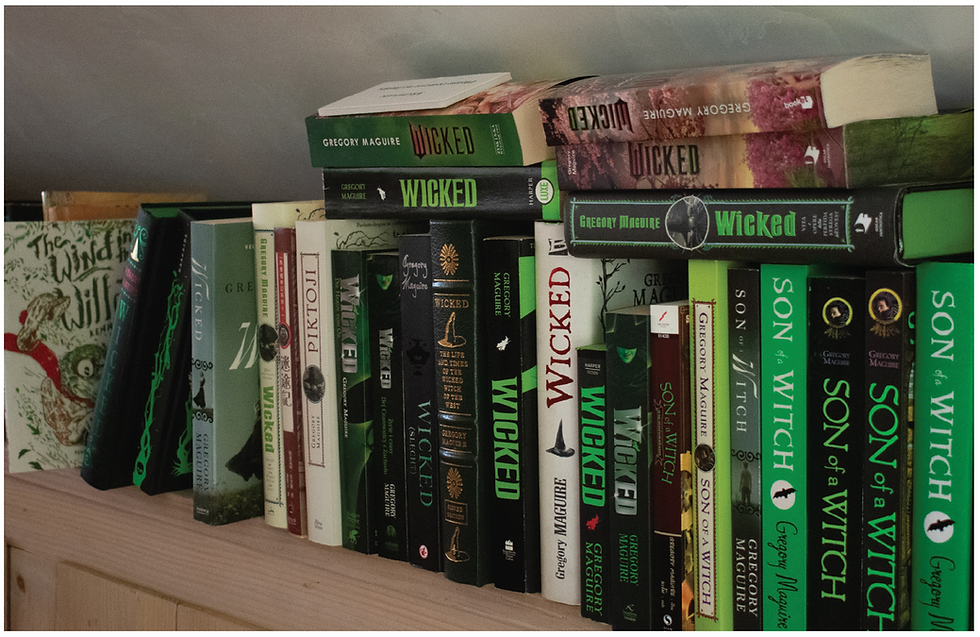
I remember seeing the book display at Shakespeare & Company Books in New York City. I was looking for a new read, and there it was: Wicked: The Life and Times of the Wicked Witch of the West by Gregory Maguire. It was 2003, just around the time the Broadway musical version was set to premiere, which gave the novel prime, eye-level real estate in the bookstore.

I had never heard of the book, the musical, or Gregory Maguire. Like many super fans of The Wizard of Oz film, I was drawn to the idea of immersing myself in the fantasy world of Oz, and here was an exciting opportunity. And from the Wicked Witch’s perspective? Compelling. I was in. The novel was published in 1995 to rave reviews, so I was admittedly late to the game, but just on time to be a part of the Wicked universe.
Wicked was just the gateway into his work, and I was eager to dive into the fairy tales and children’s stories that he turned upside down and brought firmly into the world of adult fiction. When I discovered he’d been a published writer for twenty-five years already, I realized just how late to the game I really was.
Gregory was born and raised in Albany, NY. In 1976, he graduated from the State University of New York at Albany with a BA in English. At age 24, he published his first children’s novel, The Lightning Time, in 1978. It was also the same year he got his MA in children’s literature at Simmons College, and the year he began to realize he was gay. From 1979 to 1986, he was a professor and co-director at the Simmons College Center for the Study of Children’s Literature. In 1987, Gregory co-founded a nonprofit educational charity, Children’s Literature New England, Inc., and was co-director for twenty-five years. In 1990, he earned his PhD in English and American literature from Tufts University. He has published several dozen novels and continues to release new works to this day.
He and his husband, painter Andy Newman, have three adopted children, two from Cambodia, and one from Guatemala. In 2009, the family was featured on Oprah in a segment called “Unconventional, Unforgettable Dads.” They split their time between Vermont and Massachusetts.
From his home in Strafford, VT, Gregory opens up about his family, his craft, legendary friendships in the world of children’s literature, and the long, winding, yellow-brick road that took Elphaba from the page to the stage to the silver screen.
Megan: Growing up, the library was like a sanctuary for you, one of the only places you were allowed to go as a kid.
Gregory: My own dear parents, God rest all three of their souls, were all interested in language and in literature. It was free to have a library card. Since we were not prosperous, the library was our babysitter, our governess, our Maria von Trapp, our Mary Poppins. My father was a journalist, my stepmother, who raised me, had been a poet, and my birth mother, who died when I was born, was interested in writing as well. In letters of hers that have come down to me through the ages, I can see that she had a vivid and brusque, Dorothy Parker-like tone. She also had a capacity for nonsense in her writing that neither my father nor my stepmother had, and since that’s part of my own character, I feel I really did inherit something through the chromosomes of genetics.
Beyond handing us our American citizenship and our Irish Catholicism, my parents said, “You work it out for yourselves. Write about it, think about it, and proceed on your own best instincts and your own best intellect.” That was what the library was for us. Three of my brothers became writers. My parents wanted us to be doctors or lawyers, and we all ended up wanting to write, because that was what we understood.
Megan: When did you have the epiphany that you wanted to be a writer?
Gregory: I started writing when I was about five. I stayed in as often as I could and crouched at the coffee table in the living room with scraps of paper and made stories and pictures of anything I could think of. Let’s make a map. Let’s make a comic strip. Let’s make a play. Let’s make a string of related poems. I had, and I have, I’m afraid, a ferocious need to create something every day. Some people need to swim; some people need to practice scales on their flute. I need to use language every day — by hand or on the keyboard — otherwise I feel kind of intellectually constipated.

My stepmother said to me once, “Gregory, what is the purpose of art?” I didn’t know. She said, “You have to remember — the purpose of art is to communicate. If you are not communicating, then there’s something wrong with what you’re doing.” I’ve never forgotten that as I choose how to shape a sentence, when to be nervy and brash and break the rules, and when to pull myself back from self-admiration.
Megan: You’ve kept a journal for over 60 years. Has that practice fed your writing?
Gregory: I started when I was about 13 or 14. I realized pretty early on that one of the ways to dispel a sense of responsibility for being the cause of the death of my mother — even if it was inadvertent, it was still a tragedy — was to try to live as earnestly and as attentively as I could, to soak up the life that had been denied her. The journal was a good tool for that, and it remains so. I’m just trying, right until my dying day, to live with ferocity and with intention and with vivid engagement, as a way to thank my birth parents for having brought me into the world.
The journal and the fiction writing are really separate tracks, though. I also got ideas by daring myself to do the assignments I gave to children. For a long time before Wicked was published, I was spending time in classrooms all over New England and New York as an author in residence. One of my strategies was to arrive at schools with two manila envelopes — one filled with images of real things cut from magazines, the other with images from our imaginative landscapes: a dragon, an elf, a robot, an alien. I’d say: put one hand in each envelope, take out one image from each, and write me the scene where these characters engage. It doesn’t have to have an ending or a plot, but it does have to have something so vivid that Steven Spielberg could come in tomorrow and film it. When I gave an assignment to kids, I’d always sit down and do it, too. One time I ended up writing about an ancient grandmother on her deathbed and a tooth fairy who had gotten the wrong address. That was the genesis of my book What the Dickens: The Story of a Rogue Tooth Fairy.
Megan: Two significant figures in children’s literature have played important roles in your life and career. Tell me about those relationships.
Gregory: Katherine Paterson came to speak at the Center for the Study of Children’s Literature at
Simmons College, where I was a graduate student. A colleague and I drove to Logan Airport to pick her up, and she walked through the skyway looking for someone to meet her, didn’t find anybody, walked to the end of the corridor, walked back, and found me and my colleague chatting up a storm. She approached us and said, “Are you possibly waiting for Katherine Paterson?” That was my inelegant introduction to a woman whose work I had already deeply admired — and whose friendship I hadn’t expected.
She became a permanent fixture at our conferences, and when my colleagues and I left Simmons and started a nonprofit called Children’s Literature New England, Katherine came every single summer — always a lead keynote speaker, beloved, cherished, respected, and comic. Yes, she’s funny. Always moving, always clever with the arrangement of a talk, so she would turn a corner and bring you with her before you knew what neighborhood you were going into. I learned a lot about speaking from her, and a lot about how to connect with an audience. But I also learned about the nature of friendship. She had nothing but clear-eyed regard for me as a young person and cared as much about hearing how I was doing as she ever cared to discuss how she was doing. That is the rubric of a friendship, and not everybody can carry that off.
Maurice Sendak, another dear friend, taught me to really trust the superior knowledge of the subconscious, that it usually knows more than the conscious mind about what needs to be said and what you need to do. He would just wait until his subconscious was ready to toss him another clue. I have learned to rely on that myself.
Megan: Wicked was the first adult novel you wrote after 17 years of writing only children’s books. I read that you were in London thinking about the nature of good and evil, and decided to take the Wicked Witch of the West and flesh her out, give her more of a back story. I would love to hear more about that thought process.
Gregory: When I started to write Wicked in about 1992 or ‘93, my first ambition had been to write the life story of a true sociopath or a psychopath — somebody akin to Stalin or Hitler, with menace interlaced into their integuments and pumping through their brain, through the heartless heart that lives in their heart cavity. That was my aesthetic ambition.
I gave Elphaba a dicey inception and ugliness from infancy. I gave her the aberration of a mouthful of snake teeth and the ability to seem menacing even to the people who should have loved her the best. At about page 38, when she was about one or two, I finished a certain scene by having her crawling across the floorboards of their cottage in Munchkinland, peeing on the floor, putting down her nose to smell it, and then smiling at the smell of her own pee. I meant this to seem feral and animal-like, broken and incorrect. That was my intention when I wrote that paragraph, and then I went to bed.
Next day, I got up, got my coffee, sat down at my notebook and reread the last page or two of what I’d written the day before. I write in chronological order and build on what has come the page before — and the 100 pages before. I read that paragraph about the girl being so ferocious and so unlovely, and instead of finding the next scene in which I could make her unlovelier still, my heart broke.

I read it like a reader, and I said to myself, “Oh, my gosh. Oh Elfie, nobody is ever going to get you, are they? And that’s your life. Not the life that I thought I was going to harness you, sabotage you, and enslave you into. You have a different life, and it’s not the one I thought I’d be writing. My job is now to put aside my ambitions and do something that is going to seem much more traditional and even obvious. I’m just going to follow you in your life with my reporter’s notebook and write down what I see. I’m not going to force you to play a role for my intellectual psychodrama. I’m going to try to let you be yourself and just be a responsible witness.”
Some people will call it the rehabilitation of a villain, which is not exactly what I wanted. I wanted the humanization of the villain, which is not the same thing. She does lots of bad things. She’s impatient, she’s testy, and she’s morally uncertain many times in my novel, but she’s still human. She has the capacity for guilt, for remorse, and for confusion; for love and passion, courage and insight, vision and power. She’s got everything that I could see in myself and that I can see in others. She led me through the whole plot. All I had to do was follow. It was really an easy job once I got going.
Megan: Were you surprised by the reaction to it?
Gregory: I had just gotten an agent, and he thought it was a great idea. He said, “We’re going to be able to sell this, and it’s going to do well for the first selling season, I think, and then it will subside, but it will be a permanent slow burner for many years, maybe even a couple of decades. It’s not going to be a big seller, but I’m willing to pedal it for you.” By the time the Broadway play was about to open, it had sold close to a million copies without Broadway behind it. So that was a big surprise to him, to my editors, and to me. Then Broadway happened and it went stratospheric.
Megan: And how did the Broadway show come to be?
Gregory: I started getting movie offers for Wicked within a week of its publication, because it had a glorious top of the fold, front page review in the Los Angeles Times book section. They called it an “instant classic.” Whoopi Goldberg asked about the rights, Laurie Metcalf asked, Claire Danes asked, Demi Moore asked, and a few others. We decided to go with Demi Moore because she already had a working relationship with Universal Pictures. Universal optioned it and worked for a couple of years on a script that they didn’t like, and frankly, I didn’t like either. But I had adopted three children from overseas, and the purchase price for a film, once greenlit, would have been enough to help me mostly or fully pay off my mortgage. I was ready to plug my nose, put blindfolds on, and sign that contract — but the film studio wasn’t ready to put millions of dollars into a script they didn’t think was all that powerful.
Stephen Schwartz then came upon the book about a year and a half after it was published, referred to it by his friend Holly Near, the folk singer. They were snorkeling together in Hawaii, and apparently, they bumped heads underwater, both came up, took off their masks, and he said, “What are you reading lately?” She answered, “This great book called Wicked about the Wicked Witch of the West. I think it’ll be your return to Broadway.” He went back to Universal Studios, knocked on the door of Marc Platt, the producer, and said, “Everybody tells me you’re not able to get a decent shooting script for this book. I know why — it’s because since 1939, the world has known that everyone in Oz sings. This book has to sing before it can be filmed. If you give me the permission to put it on Broadway, we can make it into an operation that you can then film in good time.” Marc said, “Works for me, but you’re going to have to persuade Gregory, because he has the rights, and he’s the one who will make the final decision.”
Stephen and I met, and he was persuasive. I thought, this is a big economic risk for my family, but I’m going to follow my instincts and say yes. It became a musical, for which I was paid in the low five figures for the rights. But in the end, that was exactly the right choice to make, because it’s now a part of world culture. At no point did I think I should write the screenplay or the play myself — I had enough humility to know that I had used the best of my talents to make the novel. What I cared about was that Stephen and book writer Winnie Holzman understood the themes of what I was trying to achieve. As long as they did, I thought it was the most honorable thing to give them carte blanche to use the best of their skills.
Megan: Before the first Wicked movie came out, you had a chance to watch some of the filming. Did you have the same opportunity on Wicked: For Good?
Gregory: I had purposely not watched any trailers, not listened to any interviews or podcasts about what the second movie was going to look or sound like. On October 27, 2025, as one of the creatives of the play, I saw a special preview by invitation only for people in the Broadway community in New York City. I went home on the train feeling like after 29 years of signing a contract with Universal Studios, I can now retire my ambition to see this on the screen before I die. So, I’m very happy about that. As I live and breathe, it was out of this world to see.
Gregory’s latest novel, Galinda: A Charmed Childhood, will be released in September 2026. It is a sister volume to Elphie: A Wicked Childhood, published in March 2025.