


VT WRITERS' 2026 PRIZE - Winning Entries

Updated: Jun 5

The Apprentice by Emily Rinkema (Prose Winner)
The first time Ellen visited the butcher was a month after Colin died. She was driving home from Hannaford and before she had time to think about why she did it, she had her blinker on and was slowing down to turn into the long driveway with the old Butcher sign nailed to a tree.
She had never been down the driveway before, and it was longer than she and Colin had imagined, winding at least a quarter mile through the woods before ending at a small white house with a surprisingly modern attached barn. There was a truck parked in front of the house and a wooden sign on a post that said OPEN, the letters burned into the wood.
Ellen parked. Colin would have laughed at the permanence of the word open. We should come back at midnight, he would have said, and then it would have become an ongoing joke. At odd times he would have said, Hey El, think the butcher’s open?
The barn was beautiful, the kind of building featured in one of those magazines about Vermont but sold mostly to people from Connecticut, people like Ellen and Colin, who spent their twenties dreaming of living on a dirt road like this one, imagining what it would be like to own a barn. She stared at the vertical wood planks, stained a deep red, nine-paned windows on either side of the black door, iron fixtures.
Colin would have told El not to come here alone, not that he would have needed to. They had imagined the type of butcher that lived in the middle of nowhere with an old sign nailed to a tree. They had made up stories of disappearing pets and lost children, of a fat, whitehaired butcher, knife in hand, bloody apron around a pot belly. It didn’t help that no one in town knew anything about the place other than that it used to be a butcher shop, twenty years ago, thirty, fifty. I think he retired, came into some money, someone said. I think he got tired, someone else said. I think he’s senile, I think his wife died, I think he died.
Ellen knew she would knock on the door. It was too late to change her mind, really. She had already parked. What else could she do now? You can leave, Colin would have said, that’s what you can do now. The first thing Ellen noticed when the butcher opened the door was that he was tall, over six feet for sure, and skinny, not at all like she and Colin had imagined. He was at least seventy-five, she thought, comparing him to her own father. The next thing that Ellen noticed was the smell. Garlic first, but also onions and thyme and something else she couldn’t name but that she felt in her chest.
“Come in,” the butcher said, as if he’d been waiting for her. She hesitated, imagining what Colin would say, but then she saw in the crinkle of his eyes that his smile was real and deep and kind and most importantly, completely devoid of sympathy.
*
The second time Ellen visited the butcher, a week after the first, she brought a bottle of wine she had chosen from among all the bottles in her pantry. Second only to frozen squash lasagnas, people had brought wine after Colin died. Maybe it was something you’re supposed to bring, that if you Google what to bring a widow, wine is the first thing that comes up.
The butcher met her at the door this time, and the smells surrounded her before she was all the way inside. There was garlic again, but this time a much deeper smell as well. She breathed in, closing her eyes.
“Roasted chicken?” she asked.
“Yes,” he said, and she handed him the bottle.
“Sit,” he said, and before Ellen could even take off her coat, he placed a plate in front of her, slabs of moist chicken, the skin the color of honey, roasted potatoes, asparagus, and over it all, a thick blanket of gravy. She hadn’t realized how hungry she was, but once she started eating she couldn’t stop. She couldn’t remember the last time she had eaten something that wasn’t thawed or microwaved. She treated each bite like it was its own meal, feeling the textures on her tongue as if she had never eaten before. The butcher watched, matching her pace, nodding as she talked between bites about important things: how she hated mushrooms and loved to clean and was afraid of hummingbirds.
“You look tired,” The butcher said. He uncorked the bottle of wine and set it between them.
“I haven’t been sleeping,” said Ellen.
*
The third time Ellen visited the butcher, the shop was brighter than the week before. New light fixtures hung over the table, which had been sanded and refinished.
The butcher came out from the back, wiping his hands on his apron. “Ellen!” he said. “You came back.”
“Of course I did,” she said, and laughed, which felt good.
They sat until the afternoon became evening. The butcher talked about meat and about the weather and about bluebirds and dirt roads and how good the wine was, all things that mattered.
*
“There’s my apprentice,” the butcher said when Ellen returned the next day. She hadn’t planned to come back, but she got up that morning so hungry she thought she might throw up from the emptiness.
“I’m sorry,” she said, sitting down at the table, which had fresh flowers in a vase in the center and two coffee mugs. “I’m sorry,” she said again, unsure exactly what she was apologizing for. Her skin felt heavy. Her eyes hurt.
“I’m so hungry,” she said.
The butcher smiled and went into the back. She listened to him whistle a tune she couldn’t quite place, something from her childhood, maybe. She thought about her mother.
The butcher returned with two large plates. There were eggs over easy, crisp bacon, potatoes with garlic and paprika. He set them on the table and sat down across from her.
“Eat,” he said.
*
The days got shorter and colder and the leaves outside her bedroom window turned from orange to brown. They hung like ornaments on the emptying limbs. Every morning Ellen got up, checked the temperature, dressed, and when it was light outside, she drove to the butcher’s, where she’d put on an apron and get to work doing what needed to be done. Winter passed.
*
One evening in March, Ellen and the butcher sat at the table after a meal. It was getting late.
“Time to close up,” the butcher said, and as she stood up, Ellen pictured the sign on the post outside, the word OPEN burned into the wood, and she laughed. She stopped. She gripped the edge of the table. Her throat closed.
“This was the one place,” she said, and there was panic in her voice. “The one place I could go and not see him or smell him or hear his voice. The one place where I couldn’t miss him.”
The butcher nodded. “I know,” he said. “But just now I thought, I can’t wait to tell Colin about this. I forgot.” Ellen sat back down. She stared at the butcher.
“I don’t know what to do,” she whispered, her breathing fast and uneven. “What do I do?”
The butcher chose a bottle of wine from a high shelf behind the counter. He turned it around in his hand, looking carefully at the label. He twisted the cork from the neck, one turn at a time, four slow twists, until it came out with a small pop, like a breath caught in a throat. “You keep going,” he said, and poured them each a glass.

Emily Rinkema has lived in Westford, VT for 30 years. Her writing has been selected for the Wigleaf Top 50, Best Short Fictions, and the Best American Nonrequired Reading anthology, and has appeared in journals such as Vestal Review, Pithead Chapel, Milk Candy Review, and SmokeLong Quarterly. She is an assistant editor for Flash Frog and believes that an upside to the shortening attention spans of readers is that more people are discovering (or re-discovering) the power of short fiction. You can read her work at emilyrinkema.com or follow her on X, BS, or IG (@emilyrinkema).
Sugarhouse Steel By Laura Kujawa (Poetry Winner)
What is it like, living there? Someone with a keyboard writes.
They attach a screenshot of the map, manacling us in a red circle
drawn with a finger. Three times a week, I drive the midriff
of my state. I roll through the valley, fog collecting in its basket.
Summer cooks this rural country, and come autumn its prime
days are preserved in amber for next year. Young green leaves
mature richer, bolder: ochres and garnets and citrines.
They caramelize themselves under a cooling sun.
Think of stomping through color, so crisp that there might as well
be potato chips underfoot. Think of your fingers, roping through
featherweight dunes of dead things and setting them loose.
Think of hiding, submerged in their sweet vegetal scent.
I follow the old quarries and their stonecutters on the highway, their
marks left in solid granite; their cemeteries: legacies left in legacy.
I pass spectral cows at graze between the windows of the woods.
Their grasses brown and then dry altogether, but they continue to eat.
You will weather this, I think to the trees when the snow comes.
To the blue-black skies, washed with drifts of white; to the car
skating on luck, shadowing the plows. To myself, and to tomorrow:
the first signs of spring bud through the ice.
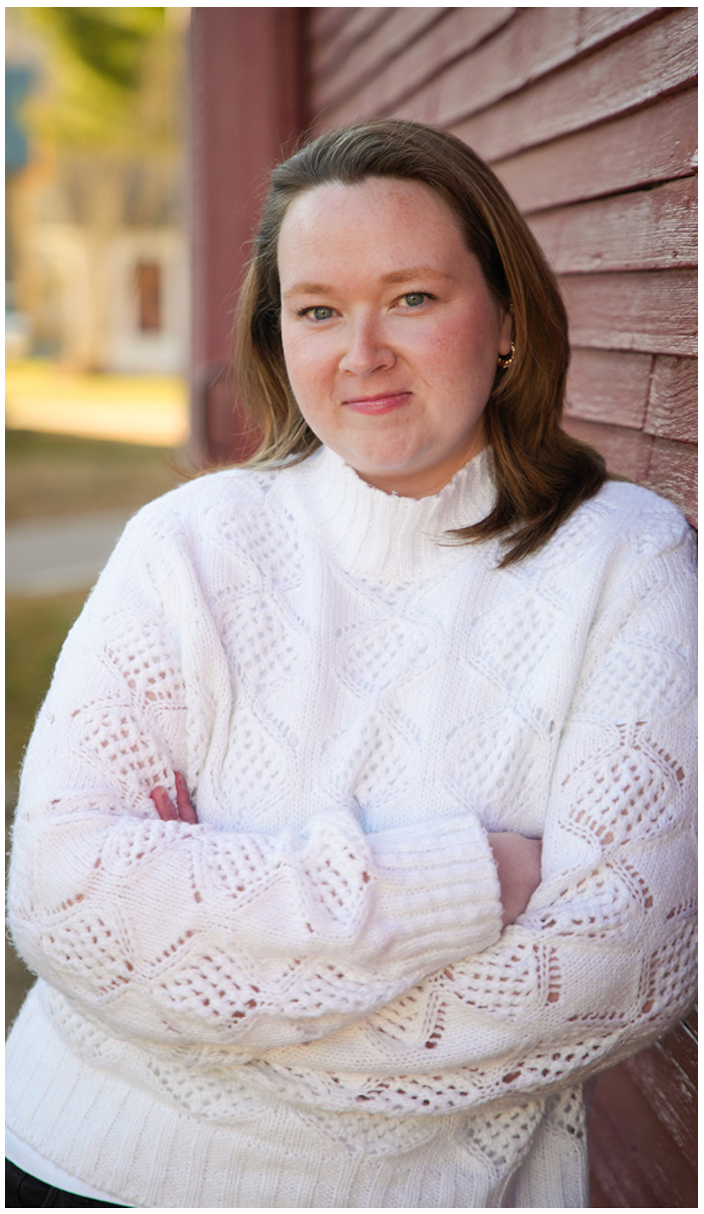
Laura Beth Kujawa is a writer and proud Vermonter. Born and raised in South Burlington, she earned her BA in English from Saint Michael’s College and MFA in Writing & Publishing from the Vermont College of Fine Arts. Her poetry and fiction have been published by Empty House Press and Washington Square Review, among other publications. She is deeply grateful for the encouragement of her fleet of friends, teachers, and mentors— past and present. Steeped in the culture, histories, and landscape of Vermont, Laura credits much of her inspiration to the Green Mountain State, and to her remarkable and endlessly supportive family. Sugarhouse Steel was written in fragments while commuting between South Burlington and South Royalton.
IN MEMORIAM…
STEPHEN C. TERRY 1942 - 2025

The Vermont Writers’ Prize was created in 1988 by Stephen C. Terry when he was at Green Mountain Power. Steve wanted to encourage Vermonters to write and be creative as well as provide a place where stories about the state he loved could be told. Steve took great joy over the years in reading the stories and poems both professional and amateur writers submitted about his favorite subject – Vermont. Sadly, Steve passed away in July 2025.
Steve dedicated his life to the good of the state. Born in Vermont in 1942, Steve spent much of his youth working at his grandparent’s farm, instilling in him a love of Vermont’s agricultural heritage and its people.
Steve’s extensive knowledge of Vermont and his commitment to working for the good of everyone made him a trusted advisor to many leaders. In 1969, Senator George Aiken recruited him to work as a legislative aide in the U.S. Senate, where he became Aiken’s lead staffer for the Senate Foreign Relations and Agriculture committees. Later, Steve authored the book Say We Won and Get Out, which details how Aiken became a leading critic of the war in Vietnam.
Writing and bringing people into history and current events, was a thread throughout Steve’s long career. Steve went on to become a journalist, where he opened the Burlington Bureau of the Rutland Herald and Times Argus newspapers, and then became founding editor of their Sunday editions. He became the managing editor of the Rutland Herald in 1977, which was subsequently recognized as one of the best small-city dailies in the country.
In 1985, Steve joined Green Mountain Power, where as a senior vice president he focused on community engagement, and encouraging environmentally and socially responsible practices that strengthened the state and helped customers.
Steve was actively involved in numerous community organizations. That work was recognized in 2014 when he was named Vermont Citizen of the Year by the Vermont State Chamber of Commerce.
In his later years, Steve was often found in his home office, built on the foundation of an old chicken coop, writing about Vermont history and politics, or on television offering political commentary. Or you might find him in the fields caring for his beloved belted cows.
Steve is remembered by those who knew him as a brilliant and sensitive person who cared deeply for Vermont and Vermonters. Former Governor Howard Dean wrote, “His knowledge of Vermont is extraordinary, as is his dedication to the people of the State of Vermont.” The Pulitzer Prize-winning editor from the Rutland Herald, David Moats, said: “It was Steve’s great quality as a citizen of Vermont that, no matter whom he was representing, the good of the state was always the backdrop of our conversations.”
At Vermont Magazine, we recognize Steve’s many contributions to the vitality and culture of Vermont. He celebrated our brave little state in all he did, especially with the written word, and we honor him and his lasting legacy.
Vermont Writers’ Prize
Honorable Mentions, Poetry & Prose
Honorable Mention, Poetry
Irene by Gordon Korstange
Hurricane from far Cape Verde,
its winds at last spent, we sighed relief
then safely to our beds we slept
through an all-night soak,
the feel of a waterfall curtain drawn
around our village from out of hill darkness,
under cover of clouds secure from gale
while headwaters in the Green Mountains
rushed into rocky stream veins
tumbled into creeks, poured into brooks,
ponds, swamps, rampant water
surging down through the valleys
and we woke to choppy waves
in our own shallow river churning from those hills
flinging fingers of white spume
leaping above the boulders below the bridge,
our river gulping its own banks
surging out to cover the sodden land
greedy for life beyond its bed
ready to suck us into its brown foam
and spit us out again gasping downstream
along with uprooted tree trunks towing their leaves,
tumbling road rubble, the wall bones of a house.
When we rushed to our impassable bridge,
its supports beginning to shudder,
bombarded by rising waves below the wet deck
river beginning to slide over it . . .
that day—that deck
where now I stand gazing like a naive tourist
at the river's stable tumble
spilling white through the rocks
serene and placid, its splashes
lapping the hours through the night
Honorable Mention, Prose
Farewell, Jack by Tyler Baker
The mountain always kept its own time, but it felt like it had skipped a beat the morning I went looking for Jack and found only his truck.
I parked where the road thinned into ruts and spruce needles, the place where I always left my car before walking the last half mile. The woods were quiet in that particular way that only happens after a hard frost—no insects ticking, no leaves whispering, just the distant knock of a woodpecker and the long breath of wind moving through hemlock boughs. I stood there longer than I needed to, listening, half-expecting to hear the familiar rhythm of an axe biting into wood. Jack’s cadence had been unmistakable: a steady, patient thud that seemed to come not from muscle alone, but from habit, from a life that had learned how to move in agreement with gravity and grain.
Nothing answered.
Ten years earlier, when I’d first bought my off-grid property, Jack had been the mountain’s punctuation mark. He lived just down the road and through the woods, far enough away that his presence didn’t intrude, close enough that it anchored the place. People talked about him the way people talk about landmarks. Turn left where Jack used to stack his birch. The storm was bad, but Jack had the road open by dawn. He was already in his eighties then, though no one said it with the reverence reserved for the fragile. They said it with a kind of astonishment, as if age had simply failed to make its case.
I remember the first time I met him. I’d been hauling lumber up the mountain, cursing my ambition and my truck in equal measure, when I came around a bend and found him standing in the road beside an old GMC with a plow mounted to its front. The truck looked like it had grown there, paint faded into the color of bark, tires half swallowed by mud. Jack wore wool pants patched at the knees and suspenders that had lost their original color decades before. He leaned on a shovel, watching me approach with a look that was neither friendly nor unfriendly—simply attentive.
“You’ll want chains,” he said, as if we’d been in the middle of a conversation.
It wasn’t a suggestion. It was weather advice, mountain advice, the kind you either took or learned from the hard way.
Over the years, our conversations never strayed far from practical. Weather. Wood. Water. The condition of the road. He had opinions on all of it, formed by repetition and consequence rather than theory. When I asked him once how long he’d lived up there, he shrugged.
“Long enough,” he said. “Too long for some. Not long enough for others.”
He split firewood by hand well into his late eighties, swinging the axe with a precision that came from knowing exactly how much effort was needed and refusing to waste any more than that. I’d offered to help once, and he’d let me for a while, watching with a faint, amused patience as I struggled against knots he would have read at a glance.
“Don’t fight it,” he told me. “The Woods got memory. You just remind it where it wants to go.”
I thought about that a lot after I left. The last time I saw him, the mountain was already leaning toward winter. His health had been failing, the kind of slow unraveling that doesn’t announce itself until it’s well underway. He sat on a low stump outside his cabin, wrapped in a blanket, the axe resting nearby like a retired tool that hadn’t yet accepted the idea. We talked about small things until he said, quietly, that he’d sold the property.
“Gonna move off the mountain,” he said. “Don’t know when.”
I remember nodding, saying something that sounded supportive, though the words felt thin. I wanted to ask him where he’d go, how he felt about leaving, whether he was afraid. I didn’t. Jack had never been a man who needed questions to fill silence. The mountain had taught him that silence was a thing you could live inside.
When I left that day, I turned back once more than usual. He was still there, a small figure against the darkening woods, and I had the strange, unwelcome thought that this might be the last time the mountain held him in place.
Today, the road felt different under my boots. It wasn’t just the absence of sound; it was the absence of expectation. I walked past the turnoff to his place, then stopped and doubled back, as if my body hadn’t quite caught up to what my eyes already knew. His cabin was gone. The clearing was there, the shape of it, but the life had been lifted out, leaving only impressions: flattened grass, a scatter of old nails, the faint rectangle where the door had once been.
And there, half sunk into the earth at the edge of the clearing, was the GMC. The plow blade was rusted through in places, flaking into the dirt. A sapling had taken root beside the front bumper, already thick enough that it would be a problem to remove. The windshield was clouded with years of dust and pollen. The truck hadn’t run in a long time; I’d known that even when Jack was still around. But seeing it now, alone and purposeless, was like finding a tool without a hand to guide it.
Jack had plowed our road for years, long after anyone would have blamed him for stopping. Storms came heavy up there, the kind that erase the idea of a road entirely, and yet somehow, by morning, there would be two clean lines cut through the white. I’d wake up to the sound of the engine echoing off the trees, a sound that meant access, continuity, the quiet assurance that someone was paying attention.
I walked around the truck, touching the cold metal, the way you might touch a headstone not for the sake of the stone, but for what it stands in for. It was surreal to imagine the mountain without him. Not because the mountain needed Jack to exist—it had been there long before him and would remain long after—but because Jack had shaped my experience of the place in ways I hadn’t fully understood until he was gone.
Living off-grid teaches you humility. It teaches you that independence is mostly a story you tell yourself, and that in practice, survival is a web of quiet interdependencies. Jack was part of that web. He was the man who knew when the thaw would turn the road to soup, who warned me before I learned the hard way. He was the man whose tracks in the snow told you someone else was still here, still paying attention to the weather, the trees, the slow turning of seasons.
I sat on the tailgate of the truck and let memory do what it does best when given time and stillness. I remembered him laughing once, a dry, surprised sound, when a log split cleanly against his expectations. I remembered the way he’d look up at the sky before answering questions about the weather, as if consulting an old friend rather than a forecast. I remembered the stories he told in fragments—about winters that lasted forever, about people who’d tried the mountain and left, about the quiet satisfaction of a stack of wood done right.
There was a kindness to him that didn’t announce itself. He wasn’t the sort of man who offered help in words, but his presence itself was a kind of help. Knowing he was there made the mountain feel inhabited rather than endured.
As I walked back toward my own place, the woods seemed to watch me in the way woods do—not with judgment, but with a steady, unblinking patience. The mountain had absorbed Jack’s years the way it absorbs everything: slowly, thoroughly, without comment. His axe strokes were probably still written somewhere in the grain of old stumps, his footsteps pressed into soil that would remember the shape of him long after the surface changed.
I stopped once more at the edge of the clearing and looked back. The GMC sat quiet, already on its way to becoming part of the landscape, iron returning to earth. I imagined Jack somewhere off the mountain, adjusting to walls closer together, to roads plowed by people who didn’t know his name. I hoped he carried the mountain with him in the way that matters—not as a place, but as a rhythm, a way of paying attention to what’s in front of you and doing the work that needs doing.
“Farewell, Jack,” I said aloud, my voice small against the trees. “May your journey be blessed with happiness, my friend.”
The words drifted into the woods and disappeared, taken up by the same silence that had always held him. And as I turned back toward my own camp, I understood something I hadn’t before: that places are made by people as much as by stone and soil, and that when someone like Jack leaves, the mountain doesn’t break—but it does, unmistakably, change.